Using 'embedded commands' - is it hypnosis, NLP, subliminal suggestion? I'm not sure, all I know is that it worked for me!
Some years back I asked a hypnotist/NLP trainer friend of mine to help me with dieting. We didn't meet up for ages, until we chanced into each other at a leadership training session.
We had a conversation about a mutual friend - we discovered that we had probably actually met before some twenty years ago in a completely different environment! After the conversation finished (I was packing up the gear from the session) I had a sort of 'eh?' moment.
Then I realised that I didn't want to eat chocolate! I looked at the biscuit tin, looked at the choccy bars, and had no urge to eat them whatsoever! So, whatever my friend had said in that conversation he had managed to help me without my even knowing.
'Embedded commands'? I don't know! It lasted about a month, which was all I needed to kick start that change in eating habits (don't call it a diet - that's a sure fire way of setting yourself up to fail).
Whatever it is/was - it worked for me. And, as I may have mentioned before, I'm not the best hypnosis subject.
Showing posts with label NLP. Show all posts
Showing posts with label NLP. Show all posts
Thursday, 15 January 2009

Monday, 12 January 2009
EFT - extremely funny therapy?
No, EFT stands for Emotional Freedom Technique. Based on Field Therapy (which you may hear people like Paul McKenna talk about frequently), Gary Craig in the US developed the technique considerably further and called it EFT.
I like EFT personally because to my mind it partners up two very powerful techniques that I already practice. The first is Karate. Well, not exactly karate, but pressure points. We know that the Chinese use these meridian points and nodes for all sorts of therapies (particularly acupuncture) but martial artists also know that pressure points are extremely sensitive. The second technique is NLP (see my post about NLP on this blog). Part of NLP is about using language to reinforce positive messages. EFT partners the physical (meridian points) with the mental (positive language) to create results that are therapeutic.
OK, EFT isn't for everyone - different techniques work for different people not just because of any scientifically proven efficacy but because of what an individual is personally happy to believe.
I took a level 1 course in EFT here in the UK with a lovely lady called Alison Munro. I had the opportunity to use EFT very shortly after completing the course when I was in the US, visiting a friend.
I use it regularly to help myself with challenges and problems and difficulties or just to make myself feel better when I'm ill.
It is not a catch all, cure all for me, but it certainly is a great tool to have in my portfolio of personal skills. I'd love to do Level 2 at some point, but life is very busy running the business and all the many other things I do that occupy my time.
I like EFT personally because to my mind it partners up two very powerful techniques that I already practice. The first is Karate. Well, not exactly karate, but pressure points. We know that the Chinese use these meridian points and nodes for all sorts of therapies (particularly acupuncture) but martial artists also know that pressure points are extremely sensitive. The second technique is NLP (see my post about NLP on this blog). Part of NLP is about using language to reinforce positive messages. EFT partners the physical (meridian points) with the mental (positive language) to create results that are therapeutic.
OK, EFT isn't for everyone - different techniques work for different people not just because of any scientifically proven efficacy but because of what an individual is personally happy to believe.
I took a level 1 course in EFT here in the UK with a lovely lady called Alison Munro. I had the opportunity to use EFT very shortly after completing the course when I was in the US, visiting a friend.
I use it regularly to help myself with challenges and problems and difficulties or just to make myself feel better when I'm ill.
It is not a catch all, cure all for me, but it certainly is a great tool to have in my portfolio of personal skills. I'd love to do Level 2 at some point, but life is very busy running the business and all the many other things I do that occupy my time.
NLP secret - using NLP every day
A couple of years ago I went on a two day introductory diploma in NLP*. Why? I'm not a trainer or a therapist, I am in marketing, I'm a singer and a writer. So, I am a communicator. NLP as a tool is highly useful in many walks of life, not just sales, therapy or training.
I'll give you some personal examples:
Meetings with suppliers or potential business partners
I have learned enough NLP to watch for body language, listen to the language the person I am meeting uses, and to build rapport successfully.
Business Writing
I think about the people I am writing to - what sort of people are they? Just because I choose email doesn't mean they will. I look at the group of people I am addressing and try to amend my copy to reflect what they may be most comfortable with, and offer alternatives for return communication. I also look through my copy to eliminate negative language.
Creative Writing
I write fiction for personal satisfaction (some published) and find that I think more about the senses when writing. Are my readers going to respond to gustatory, visual, auditory, kinaesthetic or olfactory descriptions? I remember to include each style as appropriate or, for particular effect, use one very strongly. I actually wrote a story called 'The Ghost Sniffer' following the NLP course. Imagine being able to smell history!
Networking
I have to network as a business professional but it is not a natural skill of mine. Using the NLP techniques helps me to ease into social situations more quickly.
Well, those are just a few examples of how learning even the basics of NLP have helped me. Oh, yes, it also helps when talking to recalcitrant teenagers too!
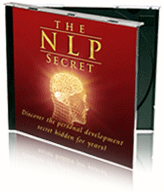
If you'd like a really easy introduction to NLP, there's a dandy CD called The NLP Secret. It's from the US and if you don't mind the extremely effusive marketing, the actual product is very good.
There are some great books too, from the simple introductory pocketbook The NLP Pocketbook, through NLP for Dummies to a whole host of advanced books focusing on different aspects of NLP.
There are also many training companies out there offering NLP training (some even offer free taster programmes) and you can become a Master Practitioner for something in the region of between £1000-£2000.
Why use NLP? I have found two schools of thought on this - from a CBT therapist who is convinced it is pure bunkum and detrimental to therapy through to those who swear by it as both a communication and therapeutic tool.
If you do a search on NLP on the internet you can find many instances of misuse of NLP as well as the positive outcomes. If you are interested in NLP, try something like The NLP Pocketbook or The NLP Secret to get a taster. If you like it, then research the training or reading materials available and take action.
* the NLP free two day diploma I went on was from a great company run by John Cassidy-Rice. If you visit their website and say you are interested, make sure they know you came via Complete Trainer, they know us well. NLP Excellence
I'll give you some personal examples:
Meetings with suppliers or potential business partners
I have learned enough NLP to watch for body language, listen to the language the person I am meeting uses, and to build rapport successfully.
Business Writing
I think about the people I am writing to - what sort of people are they? Just because I choose email doesn't mean they will. I look at the group of people I am addressing and try to amend my copy to reflect what they may be most comfortable with, and offer alternatives for return communication. I also look through my copy to eliminate negative language.
Creative Writing
I write fiction for personal satisfaction (some published) and find that I think more about the senses when writing. Are my readers going to respond to gustatory, visual, auditory, kinaesthetic or olfactory descriptions? I remember to include each style as appropriate or, for particular effect, use one very strongly. I actually wrote a story called 'The Ghost Sniffer' following the NLP course. Imagine being able to smell history!
Networking
I have to network as a business professional but it is not a natural skill of mine. Using the NLP techniques helps me to ease into social situations more quickly.
Well, those are just a few examples of how learning even the basics of NLP have helped me. Oh, yes, it also helps when talking to recalcitrant teenagers too!
If you'd like a really easy introduction to NLP, there's a dandy CD called The NLP Secret. It's from the US and if you don't mind the extremely effusive marketing, the actual product is very good.
There are some great books too, from the simple introductory pocketbook The NLP Pocketbook, through NLP for Dummies to a whole host of advanced books focusing on different aspects of NLP.
There are also many training companies out there offering NLP training (some even offer free taster programmes) and you can become a Master Practitioner for something in the region of between £1000-£2000.
Why use NLP? I have found two schools of thought on this - from a CBT therapist who is convinced it is pure bunkum and detrimental to therapy through to those who swear by it as both a communication and therapeutic tool.
If you do a search on NLP on the internet you can find many instances of misuse of NLP as well as the positive outcomes. If you are interested in NLP, try something like The NLP Pocketbook or The NLP Secret to get a taster. If you like it, then research the training or reading materials available and take action.
* the NLP free two day diploma I went on was from a great company run by John Cassidy-Rice. If you visit their website and say you are interested, make sure they know you came via Complete Trainer, they know us well. NLP Excellence
Subscribe to:
Posts (Atom)